
Small kitchens change what “best espresso machine” means. Width matters, but so do depth, cabinet clearance and whether the machine also requires a separate grinder beside it. A narrow espresso machine can still consume significant counter space once the complete setup is considered.

How this guide was built: Espresso Index has not personally tested these machines side by side. We compare current manufacturer specifications, product documentation and the research already used in our individual reviews. We focus on total kitchen fit, not simply machine width.
Our Picks at a Glance
| Machine | Best fit | Approx. width | Separate grinder? |
|---|---|---|---|
| Breville Bambino BES450 | Narrowest semi-automatic setup | About 6.1 in | Yes, for whole beans |
| De’Longhi Classic EM350BK | Simple compact semi-automatic alternative | Compact body | Yes, for whole beans |
| Gaggia Classic Pro E24 | Compact traditional 58 mm platform | About 8 in | Yes |
| Philips 3300 LatteGo | Compact fully automatic bean-to-cup setup | About 9.7 in | No |
The Most Important Small-Kitchen Question: Machine Width or Total Setup?
Machine width alone can be misleading.
The Breville Bambino and Gaggia Classic Pro E24 are narrow espresso machines, but neither includes a grinder. If you use whole beans, the grinder needs its own counter space. A fully automatic machine such as the Philips 3300 is wider, but the grinder is already integrated into the appliance.
For a genuinely small kitchen, compare the width and depth of the complete coffee setup rather than the brewer by itself.
Breville Bambino BES450: Best for the Narrowest Counter Space
The Bambino is the strongest fit in this group when the espresso machine itself needs to be as narrow as possible.
- Approximately 6.1 inches wide
- ThermoJet heating with roughly three-second startup
- 54 mm portafilter
- Manual steam wand
- No integrated grinder
- Dedicated hot-water function
Why it works in a small kitchen: its narrow body leaves more usable counter width than the other machines in this guide. The fast-heating system also suits buyers who do not want to leave a larger traditional machine warming on the counter.
Main trade-off: the Bambino is only part of the setup if you want freshly ground coffee. A capable espresso grinder beside it can erase some of the counter-space advantage.
Read our full Breville Bambino BES450 Product Review.
For another integrated-vs-separate-grinder perspective, see our Breville Bambino vs. Breville Barista Express comparison.
De’Longhi Classic EM350BK: Best Simple Compact Alternative
The De’Longhi Classic EM350BK is another compact semi-automatic option aimed at buyers who want a relatively uncomplicated machine.
- Compact semi-automatic design
- Thermoblock heating
- Programmable single and double espresso
- Automatic shot stopping
- Manual steam wand
- Approximately 57 oz removable water tank
- No integrated grinder
Why it works in a small kitchen: the machine is designed around a relatively compact footprint without adding an integrated grinder or a large automatic milk system.
Main trade-off: just like the Bambino, the total setup grows once a separate grinder is added. Buyers also give up the broader control and 58 mm platform available on the Gaggia.
Read our full De’Longhi Classic EM350BK Product Review.
Gaggia Classic Pro E24: Best Compact Traditional 58 mm Setup
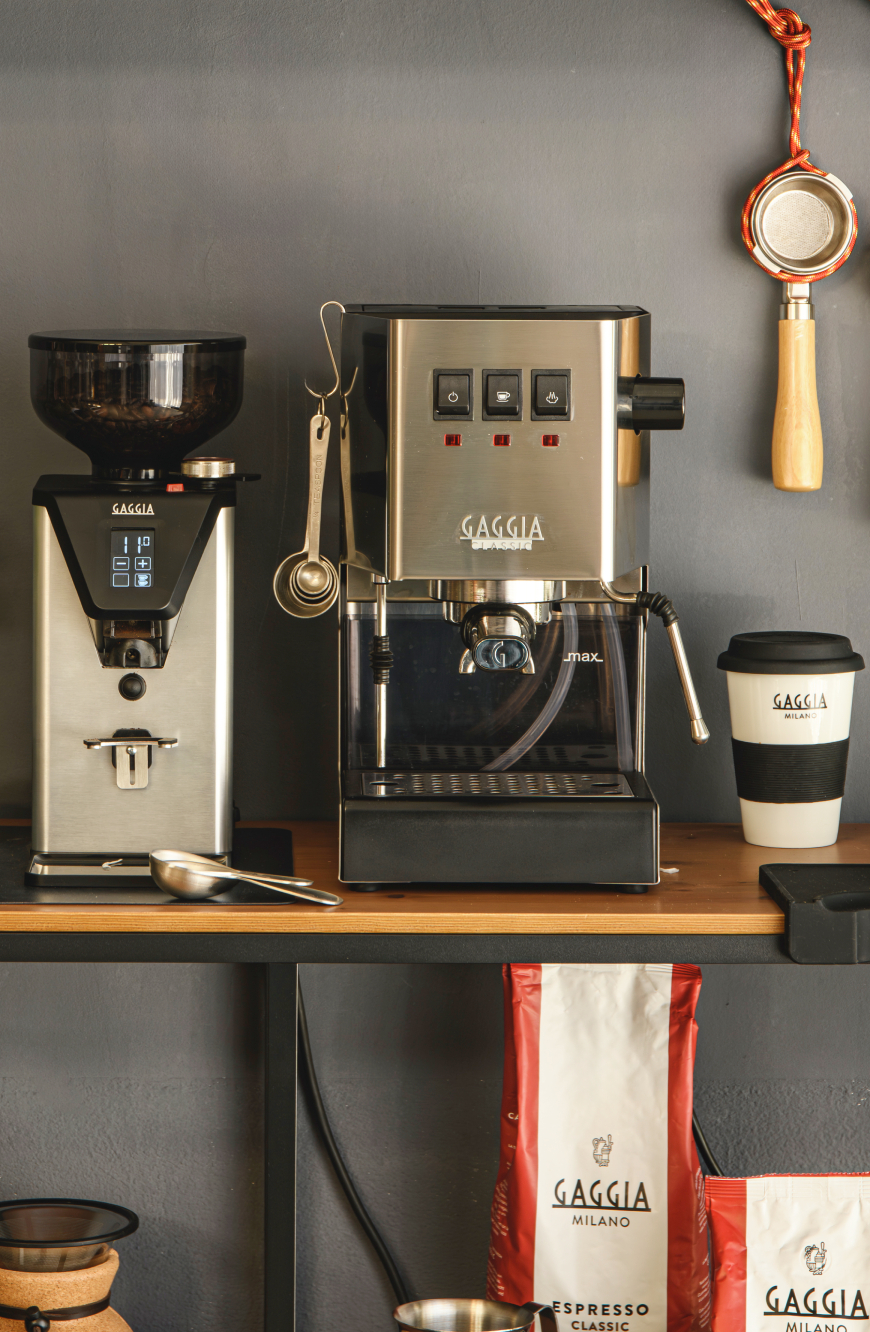
The Gaggia Classic Pro E24 is narrow enough to fit many smaller kitchens while offering a more traditional espresso platform than the other semi-automatic machines in this guide.
- Approximately 8 inches wide
- 58 mm stainless-steel portafilter
- Lead-free brass boiler
- Commercial-style manual steam wand
- 72 oz water reservoir
- 9-bar brewing configuration
- No integrated grinder
Why it works in a small kitchen: the narrow body provides a traditional 58 mm home-barista platform without requiring the width of a grinder-equipped all-in-one machine.
Main trade-off: it still requires a separate grinder, and the single-boiler workflow is less convenient than rapid-heating or fully automatic systems. Cabinet clearance also matters because the machine is taller than the Bambino and needs practical access for filling and daily use.
Read our full Gaggia Classic Pro E24 Product Review.
Philips 3300 LatteGo: Best Compact Fully Automatic Option

The Philips 3300 is wider than the Bambino or Gaggia, but its built-in grinder and automatic milk system make it worth considering when total setup size matters more than machine width alone.
- Approximately 9.7 inches wide
- Integrated ceramic grinder with 12 settings
- Automatic bean-to-cup brewing
- LatteGo automatic milk system
- Five coffee recipes plus hot water
- 1.8 L water tank
- No separate grinder required
Why it works in a small kitchen: the machine consolidates grinder, brewer and automatic milk preparation into one appliance. A separate-grinder semi-automatic setup may occupy more combined counter width even when the espresso machine itself is narrower.
Main trade-off: the Philips is considerably taller and deeper than the Bambino, so cabinet clearance and front-to-back space matter. Buyers also sacrifice the direct control of a traditional portafilter machine.
Read our full Philips 3300 LatteGo EP3341/50 Product Review.
For a deeper look at fully automatic machines, see our Best Automatic Espresso Machines buying guide.
Small-Kitchen Comparison
| Feature | Bambino | De’Longhi Classic | Gaggia E24 | Philips 3300 |
|---|---|---|---|---|
| Machine style | Semi-automatic | Semi-automatic | Semi-automatic | Fully automatic |
| Integrated grinder | No | No | No | Yes |
| Milk system | Manual wand | Manual wand | Manual wand | Automatic LatteGo |
| Primary space advantage | Very narrow body | Compact simplicity | Narrow 58 mm platform | All-in-one setup |
| Main space drawback | Needs separate grinder | Needs separate grinder | Needs separate grinder | Taller and deeper |
What to Measure Before Buying
Counter Width
Measure the entire coffee station, including grinder width if the machine does not include one. Leave enough room to remove the portafilter and operate the steam wand comfortably.
Counter Depth
A narrow machine can still project far forward on a shallow counter. Depth becomes particularly important with fully automatic machines that contain an internal brew group and larger water system.
Cabinet Clearance
Check how much vertical room remains beneath upper cabinets. You may need clearance to access a bean hopper, fill a water tank, warm cups or remove components for cleaning.
Access for Cleaning
Do not plan a space so tightly that the machine has to be moved every time the drip tray, water tank or brew components need cleaning.
Which Machine Makes the Most Sense?
- Choose the Breville Bambino if the machine itself needs to be as narrow as possible and you are comfortable adding a separate grinder.
- Choose the De’Longhi Classic EM350BK if you want a compact, straightforward semi-automatic machine with programmable shot stopping.
- Choose the Gaggia Classic Pro E24 if you want a compact traditional 58 mm espresso platform and are willing to devote space to a separate grinder.
- Choose the Philips 3300 LatteGo if consolidating grinder, brewing and automatic milk preparation into one appliance is more important than having the narrowest machine.
Buying Guide Conclusion
For the smallest kitchens, the best machine depends on what is actually limiting your space.
The Breville Bambino is the strongest choice when counter width is the main constraint.
The Gaggia Classic Pro E24 offers a more traditional 58 mm platform while remaining relatively narrow.
The Philips 3300 LatteGo can make more sense when you want one appliance to replace the separate grinder, brewer and milk-preparation workflow.
The key is to measure the complete setup—not just the espresso machine—and account for the space needed to fill, operate and clean it.
Sources
- Breville — Bambino BES450 product information
- De’Longhi — Classic EM350BK product information
- Gaggia North America — Classic Pro E24 specifications
- Philips — Series 3300 EP3341/50 product information
Methodology: This guide is research-based. Espresso Index has not personally tested these machines side by side. Recommendations are based on manufacturer specifications, physical dimensions, workflow, grinder requirements and buyer fit. Specifications can change, so key details are periodically rechecked.

Comments
3 responses to “Best Espresso Machines for Small Kitchens: Research-Based Picks for Limited Counter Space”
[…] a small kitchen, total setup size is more useful than machine width alone. Our Best Espresso Machines for Small Kitchens guide compares that issue […]
LikeLike
[…] needs grinder space for whole beans. The Philips 3300 is wider, but its grinder is built in. Our Best Espresso Machines for Small Kitchens guide compares total setup space […]
LikeLike
[…] Best Espresso Machines for Small Kitchens […]
LikeLike