
The Gaggia Classic Pro E24 is a compact, manually controlled espresso machine built around a 58 mm portafilter, single brass boiler and commercial-style steam wand. It is aimed less at buyers seeking automation and more at people who want a traditional home-barista workflow.
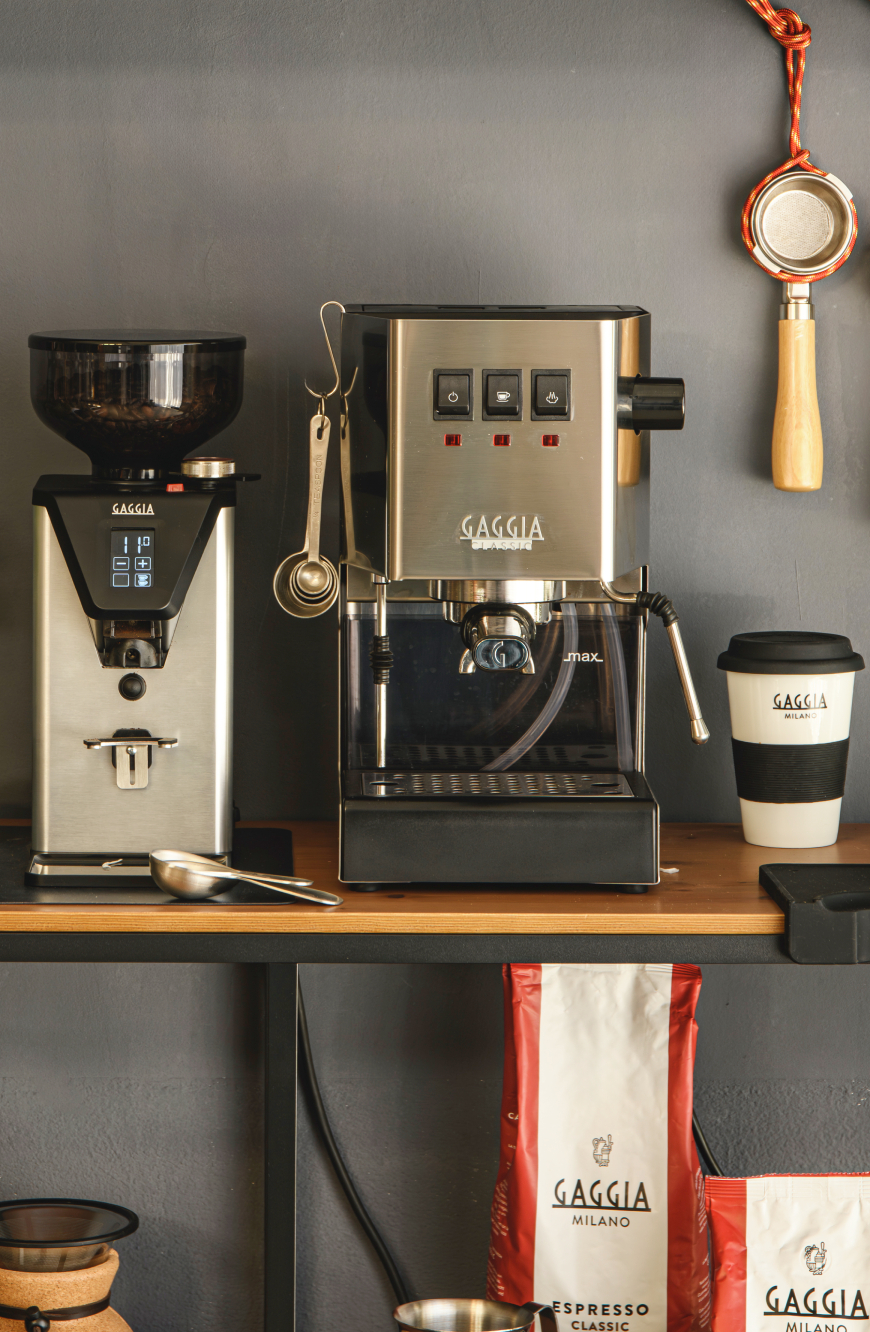
Review basis: Espresso Index has not personally tested the Gaggia Classic Pro E24. This product review is based on current Gaggia specifications and documentation together with published independent hands-on testing. We do not assign numeric ratings to products we have not personally tested.
Product Summary
- Model: Gaggia Classic Pro E24
- Type: Semi-automatic espresso machine
- Boiler: Single-boiler, dual-use
- Boiler material: Lead-free brass
- Boiler capacity: Approximately 3.5 oz
- Portafilter: 58 mm stainless steel
- Brew pressure: 9-bar OPV calibration
- Pump: 15-bar Italian-made Ulka pump
- Steam wand: Commercial-style stainless-steel wand
- Steam tip: Two-hole
- Water reservoir: 72 oz
- Body: One-piece stainless-steel housing
- Dimensions: Approximately 8 × 9.5 × 14.2 inches
- Weight: Approximately 19 lb
- Made in: Italy
What the Classic Pro E24 Is Designed to Do
The Classic Pro E24 takes a traditional approach to home espresso.
There is no built-in grinder, automatic dosing system or one-touch drink menu. The user chooses the grinder, prepares the coffee, locks in the portafilter, starts and stops brewing, and steams milk manually.
That makes it fundamentally different from machines designed around convenience and automation. Its appeal is direct control, relatively simple mechanical operation and compatibility with standard 58 mm espresso equipment.
Pros
- Lead-free brass boiler
- 58 mm stainless-steel portafilter
- 9-bar brew-pressure calibration
- Commercial-style two-hole steam wand
- Large 72 oz water reservoir
- Three-way solenoid valve
- Stainless-steel body
- Simple mechanical rocker-switch controls
- Accepts a broad range of 58 mm accessories
- Separate grinder can be upgraded independently
Cons
- No integrated grinder
- No factory PID temperature controller
- Single boiler cannot brew and steam simultaneously
- Manual workflow requires more technique than automated machines
- Milk steaming requires practice
- Best results depend heavily on grinder quality
- Requires more patience than rapid-heating ThermoJet-style machines
The E24 Brass Boiler
The defining change in the E24 generation is the switch to a lead-free brass boiler.
Previous versions of the modern Classic used an aluminum boiler. Brass has considerably greater mass, allowing the boiler to retain heat more effectively once fully warmed.
Independent hands-on testing of the E24 found that the brass boiler cycled its heating element less frequently and maintained a narrower temperature range than the previous aluminum-boiler version.
This does not turn the Classic Pro E24 into a temperature-adjustable PID machine, but the increased thermal stability is a meaningful improvement for a design that otherwise remains deliberately simple.
58 mm Portafilter and Group
The Classic Pro E24 uses a 58 mm stainless-steel portafilter and a brass group head.
The 58 mm format is significant because it is widely used throughout traditional espresso equipment. That gives owners access to a large ecosystem of baskets, tampers, distribution tools and other accessories.
It also makes the machine attractive to buyers who want to learn espresso using equipment that more closely resembles the format used by many higher-end machines.
9-Bar Brewing Pressure
Gaggia currently specifies the E24 with an Italian-made 15-bar Ulka pump and an over-pressure valve calibrated to approximately 9 bar for brewing.
The distinction matters because the pump’s maximum capability is not the same as the pressure intended at the coffee puck during espresso extraction.
The E24 is configured around the approximately 9-bar pressure traditionally associated with espresso brewing.
No Built-In Grinder
The Classic Pro E24 does not include a grinder.
For buyers starting from scratch, that means the true setup requires both the espresso machine and an espresso-capable grinder.
This increases the initial equipment requirement compared with an integrated machine such as the Breville Barista Express or Ninja Luxe Café Premier.
The advantage is flexibility. The grinder is completely independent from the espresso machine and can be selected or upgraded without replacing the E24.
Why Grinder Quality Matters
A capable grinder is particularly important with a manual machine like the Classic Pro E24.
Small changes in grind size affect how quickly water moves through the coffee puck. Because the E24 does not automatically adjust the grind or compensate for the user’s preparation, the grinder becomes a major part of controlling extraction.
Buyers planning to use traditional non-pressurized baskets should therefore account for the grinder when considering the total cost of the setup.
Commercial-Style Steam Wand
The E24 uses a stainless-steel commercial-style steam wand with a two-hole tip.
Milk steaming is completely manual. The user controls how much air is introduced, how the milk circulates and when steaming stops.
Independent hands-on testing found the E24 capable of producing fine-textured milk suitable for cappuccinos and latte-style drinks when used with appropriate technique.
The trade-off is the learning curve. Buyers who want the machine to texture milk automatically should look toward a more automated system.
Single-Boiler Workflow
The Classic Pro E24 is a single-boiler, dual-use machine.
The same boiler is used for both brewing espresso and generating steam, so the machine cannot perform both functions simultaneously.
After brewing, the boiler must increase its temperature before steaming. After steaming, it must return to brewing temperature before another espresso is prepared.
For one or two drinks at a time, this workflow may be perfectly reasonable. For households preparing several milk drinks back to back, a dual-boiler or heat-exchanger machine would provide a faster workflow.
Three-Way Solenoid Valve
The Classic Pro E24 includes a three-way solenoid valve.
When brewing stops, the valve releases pressure from the group and redirects excess water toward the drip tray.
This helps leave the coffee puck comparatively dry and makes removing the portafilter and cleaning up after extraction more convenient.
Controls
The E24 uses three mechanical rocker switches for power, brewing and steaming, together with indicator lights and a separate steam-control knob.
There is no touchscreen and no drink-selection interface.
The simplicity reduces automation but also keeps the interaction straightforward: the user directly controls the fundamental functions of the machine.
Temperature Control
The Classic Pro E24 does not include an adjustable PID temperature controller from the factory.
Instead, the machine uses thermostatic control combined with the improved thermal mass of its brass boiler and group.
For users who want to select an exact brewing temperature for different coffees, this is an important limitation compared with machines offering factory-installed PID control.
For buyers who prefer a simpler machine and are comfortable learning its temperature behavior, the E24’s brass boiler provides a stronger foundation than the previous aluminum design.
Water Reservoir
Gaggia lists the water reservoir at 72 oz.
That is a relatively generous capacity for a compact machine and should reduce the frequency of refilling compared with machines using substantially smaller tanks.
As with any espresso machine, water quality also matters. Appropriate filtration and regular descaling can help reduce mineral accumulation inside the boiler and water circuit.
Size and Counter Space
Gaggia currently lists the Classic Pro E24 at approximately 8 inches wide, 9.5 inches deep and 14.2 inches high, with a weight of approximately 19 pounds.
The 8-inch width makes the machine relatively narrow, although buyers must also reserve counter space for a separate grinder.
Cabinet clearance should also be considered when accessing the top of the machine or warming cups.
Build and Materials
The E24 uses a one-piece stainless-steel body, brass boiler and group head, stainless-steel portafilter and stainless-steel steam wand.
This emphasis on metal components is one of the ways the Classic Pro E24 differs from many entry-level machines that use more plastic in their exterior construction and brewing components.
Who Is the Gaggia Classic Pro E24 Best Suited For?
- Buyers who want a traditional semi-automatic espresso workflow
- People who want a 58 mm portafilter platform
- Users who already own or plan to buy a capable espresso grinder
- People interested in learning grind, dose, tamping and extraction
- Buyers who prefer manual milk steaming
- Users who value simple mechanical controls
- People who want their grinder and espresso machine to remain separate
Who Is It Less Suited For?
- Buyers who want a built-in grinder
- People who want one-touch espresso drinks
- Users who want automatic milk frothing
- Households regularly preparing many milk drinks back to back
- Buyers who want factory-adjustable PID temperature control
- People who do not want to learn manual espresso technique
Gaggia Classic Pro E24 vs. Breville Bambino
The Gaggia Classic Pro E24 and Breville Bambino are both compact semi-automatic machines without integrated grinders, but their design priorities are different.
The Bambino emphasizes rapid startup through its ThermoJet heating system and a very narrow footprint.
The Gaggia emphasizes its brass single boiler, 58 mm portafilter, traditional controls and commercial-style component layout.
A buyer prioritizing speed and simplicity may prefer the Bambino. Someone wanting a more traditional 58 mm home-barista platform may find the Gaggia more appealing.
Gaggia Classic Pro E24 vs. Barista Express
The Barista Express includes its own grinder, while the Gaggia requires a separate grinder.
That makes the Barista Express easier to purchase as a complete setup, but the Gaggia allows the grinder and espresso machine to be selected and upgraded independently.
The Gaggia also uses the wider 58 mm portafilter format, while the Barista Express uses Breville’s 54 mm system.
Product Review Conclusion
The Gaggia Classic Pro E24 is fundamentally a machine for buyers who want to participate in the espresso-making process rather than have the machine automate it.
Its strongest attributes are the brass boiler, 58 mm portafilter, 9-bar brewing configuration, commercial-style steam wand, three-way solenoid valve and relatively straightforward mechanical design.
Its limitations are equally clear. There is no grinder, no automatic milk system, no one-touch drink preparation and no factory-adjustable PID temperature control. The single boiler also means brewing and steaming must happen sequentially.
Our assessment: the Classic Pro E24 appears best suited to buyers who want a traditional, manually controlled espresso platform and are willing to pair it with a capable grinder. Buyers who prioritize automation, instant preparation or an integrated grinder will likely be better served by a different type of machine.
Sources
- Gaggia North America — Classic Pro E24 specifications and product documentation
- Whole Latte Love — Gaggia Classic Pro E24 hands-on testing and review
Methodology: Espresso Index has not personally tested this machine. We compare manufacturer specifications with published independent hands-on testing and clearly distinguish researched findings from firsthand experience. Product specifications can change, so key details are periodically rechecked.


